




Selecting the right shower door hinge is essential for the smooth operation, safety, and long-term stability of a frameless glass enclosure.
A hinge should not be selected only by appearance or finish. The mounting type, glass thickness, door size, door weight, door width, opening direction, and closing function all need to match the enclosure design.
Below are the main technical points to check when choosing frameless shower door hinges.
1. Determine the Mounting Configuration
The first step is to confirm how the moving glass door is connected to the surrounding structure.
The most common hinge configurations include:
Wall-to-Glass Hinges
Wall-to-glass hinges connect the shower door directly to the wall.
This is one of the most common configurations for frameless shower enclosures. When selecting this type of hinge, it is important to make sure the wall structure and fixing position can support the weight and repeated movement of the glass door.
Glass-to-Glass Hinges
Glass-to-glass hinges connect the shower door to a fixed glass panel.
Common angles include:
- 90° glass-to-glass
- 135° glass-to-glass
- 180° glass-to-glass
The correct angle depends on the enclosure layout. The fixed glass panel must also be installed securely because it carries part of the load from the moving door.
Pivot Hinges
Pivot hinges support the door from the top and bottom instead of using the standard side-mounted hinge position.
They are used in certain shower door designs where a different opening layout or pivoting movement is required. In this type of system, the upper and lower pivot points must remain correctly aligned on the same vertical axis.
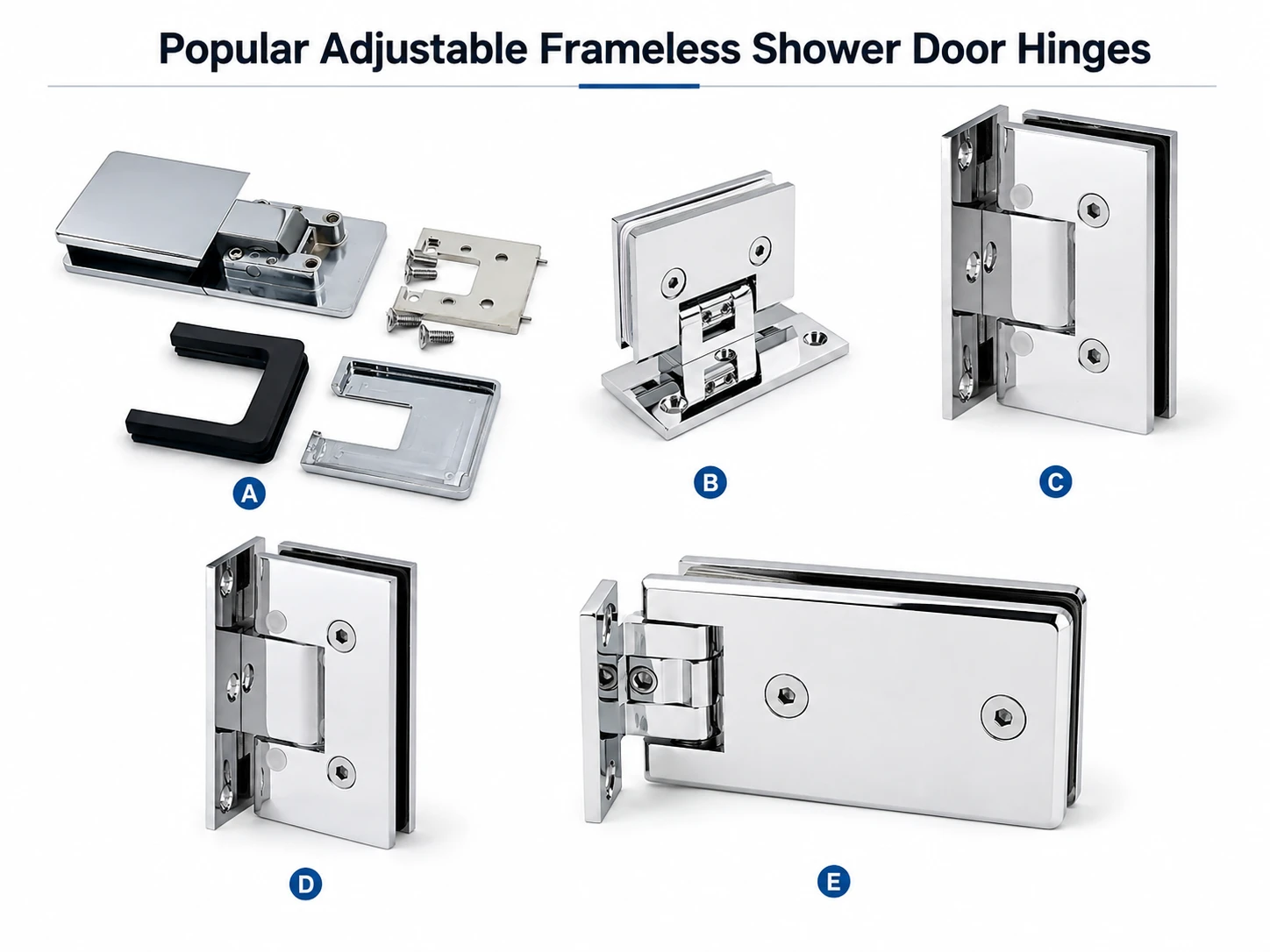
Adjustable Hinges
Some shower hinges are designed with adjustable features.
Depending on the hinge design, the adjustment may apply to the glass position, the closing position, or the zero position. These hinges are often useful when the wall or enclosure is not perfectly square.
2. Match the Glass Thickness
The hinge must match the actual glass thickness.
Frameless shower doors commonly use:
- 8 mm tempered glass
- 10 mm tempered glass
- 12 mm tempered glass
Some hinge models are designed to work with more than one glass thickness by using different gasket combinations.
The gasket is important because it helps protect the glass and provides the clamping pressure needed to hold the door securely. Using the wrong gasket combination may reduce holding force or create unnecessary pressure on the glass.
3. Calculate the Door Weight
Door weight is one of the most important factors in hinge selection.
As a rough reference:
- 8 mm glass weighs about 20 kg/m²
- 10 mm glass weighs about 25 kg/m²
- 12 mm glass weighs about 30 kg/m²
For example, if a 10 mm glass door measures 800 mm × 2000 mm, its approximate glass weight is:
0.8 × 2.0 × 25 = 40 kg
The hinge system should always be selected according to the manufacturer’s rated capacity. It is not advisable to use a hinge continuously at the limit of its load range.
4. Door Width Also Matters
Weight is not the only thing that affects hinge performance.
Door width is also important because a wider door creates more leverage on the hinge. Even when two doors have a similar weight, the wider one usually puts more stress on the upper hinge.
For this reason, hinge selection should consider both:
- total door weight
- door width
For wider or heavier shower doors, it may be necessary to use a heavy-duty hinge or a three-hinge arrangement, depending on the hinge series.
5. Check the Required Opening Angle
The enclosure layout determines how the door needs to open.
Common opening arrangements include:
- 90°
- 135°
- 180°
- inward opening
- outward opening
- two-way opening
Not all hinges allow the same opening range. The surrounding wall, fixed glass, handle, and other hardware should also be checked to ensure the door can open without obstruction.
6. Decide Whether Self-Closing Is Required
Many shower hinges use an internal spring or cam mechanism to help return the door toward the closed position.
Some hinges have a fixed factory closing position. Others allow limited zero-position adjustment, depending on the hinge design.
A fixed-position hinge may be suitable for a standard square enclosure. If the wall is slightly out of plumb or the magnetic seal requires more precise alignment, an adjustable hinge may be more suitable.
7. Confirm the Number of Hinges Required
Two hinges are commonly used for standard shower doors.
However, the allowable door size and weight always depend on the specific hinge model.
For taller, wider, or heavier doors, it may be necessary to use a heavy-duty hinge series or a three-hinge configuration. This should always be checked against the actual hinge specification.
8. Confirm the Glass Cut-Out Requirements
Different hinges require different glass cut-outs.
Before ordering the glass, confirm:
- cut-out shape
- hole location
- edge distance
- top and bottom hinge position
This step is very important because tempered glass normally cannot be drilled or reworked after processing. The glass preparation must match the technical drawing provided for the hinge.
9. Consider Material and Finish
After confirming the technical requirements, the hinge material and finish can be selected.
Common finishes include:
- Chrome
- Satin Nickel
- Matte Black
- Gold
- PVD finishes
In shower applications, corrosion resistance and durability are just as important as appearance. The hinge material and finish should be suitable for long-term use in a wet bathroom environment.
Common hinge materials include solid brass and stainless steel, depending on the hinge design and application.
10. Do Not Choose a Hinge Only by Appearance
Two shower hinges may look very similar from the outside but still differ greatly in:
- load capacity
- internal mechanism
- glass thickness range
- opening angle
- gasket design
- installation requirements
For this reason, it is not enough to choose a replacement hinge based only on appearance.
When replacing an existing hinge, it is better to confirm the glass size, glass thickness, hinge cut-out, and installation type before making a selection.
Information Needed to Recommend a Shower Hinge
If you are not sure which hinge is suitable for your project, the following information is usually needed:
- glass thickness
- door width
- door height
- approximate door weight
- wall-to-glass or glass-to-glass installation
- required hinge angle
- opening direction
- fixed or adjustable closing position
- installation drawing or enclosure sketch
With this information, the correct hinge type can usually be selected much more accurately.
Need Help Selecting a Shower Door Hinge?
MAXGO manufactures frameless shower door hinges for different glass thicknesses, door sizes, and enclosure configurations.
If you are selecting hardware for a new project or replacing an existing hinge, send us your glass thickness, door dimensions, and installation drawing. We can help check the suitable hinge type, load requirement, and glass cut-out before production.