

Shower door rollers may look like simple hardware, but they have a direct effect on how smoothly a sliding glass door moves, how accurately it stays aligned, and how long the complete enclosure performs without maintenance problems.
Selecting a roller by appearance or wheel diameter alone is not enough.
For new shower enclosure production, the roller must match the glass thickness, panel weight, track profile, mounting position and adjustment method.
For replacement projects, dimensional compatibility becomes even more important. Two rollers may look almost identical but use different wheel offsets, glass holes, axle positions or mounting systems.
Below are the main technical points to check when selecting shower door rollers.
1. Identify the Sliding Door System
The first step is to understand how the moving glass panel is supported.
Top-Hung Systems
In a top-hung sliding system, the main roller assemblies run on an upper track and carry most of the moving door load.
The lower part of the glass normally uses a guide or secondary component to keep the panel aligned.
For this type of system, the upper roller body, axle and bearing arrangement must be suitable for the actual glass weight and track design.
Bottom-Rolling Systems
Some shower enclosures support the door mainly on rollers running along a lower rail.
Because the bottom track is exposed to water, soap residue and dirt, regular cleaning is particularly important.
Contamination inside the rail can increase rolling resistance and accelerate wheel or bearing wear.
Multi-Roller Systems
Many shower doors use multiple rollers at the top and bottom.
The exact load distribution depends on the enclosure design. Some rollers primarily carry the door while others stabilize or guide it.
For this reason, replacement rollers should be matched to the complete system rather than selected as isolated components.
Curved Shower Door Systems
Curved shower enclosures require roller geometry that matches the track radius.
Wheel position, roller offset and track curvature all affect how smoothly the glass follows the rail.
A roller designed for a straight track should not automatically be assumed to work on a curved enclosure.
2. Match the Glass Thickness
The roller assembly must be compatible with the actual glass thickness.
Common shower enclosure glass thicknesses include:
- 6 mm
- 8 mm
- 10 mm
- 12 mm for some heavier systems
Glass thickness affects:
- mounting body clearance
- gasket thickness
- fixing screw length
- clamp position
- overall roller offset
The gasket must protect the glass while allowing the roller body to clamp securely.
Using an incorrect gasket or mounting combination can lead to movement around the glass hole or unnecessary local pressure.
3. Calculate the Approximate Glass Weight
Glass weight is one of the basic parameters when selecting a roller system.
As a rough reference:
- 6 mm tempered glass: about 15 kg/m²
- 8 mm tempered glass: about 20 kg/m²
- 10 mm tempered glass: about 25 kg/m²
- 12 mm tempered glass: about 30 kg/m²
For example, an 8 mm glass door measuring 700 mm × 1900 mm weighs approximately:
0.7 × 1.9 × 20 = 26.6 kg
The complete roller system should be selected according to the manufacturer’s rated door weight and intended configuration.
Avoid selecting a roller system that operates continuously at the maximum stated load without considering the actual installation.
4. Match the Wheel Geometry to the Track
Wheel diameter is important, but it is only one part of the matching process.
The wheel and track work as one system.
Important dimensions include:
- outer wheel diameter
- wheel width
- wheel groove shape
- axle position
- wheel-to-glass offset
- track width
- track profile
- track radius for curved systems
Small dimensional differences can change door height, seal alignment or how the wheel sits inside the rail.
For replacement rollers, measure the original roller and track rather than relying only on photographs.
5. Confirm the Glass Hole and Mounting Position
This is one of the most important checks for replacement shower rollers.
Tempered glass normally cannot be drilled, cut or reworked after tempering.
The replacement roller therefore needs to match the existing glass preparation.
Measure:
- hole diameter
- number of holes
- hole spacing
- center of hole to glass edge
- mounting direction
- wheel center position relative to the glass
- required gasket arrangement
For new OEM projects, confirm the roller drawing before the glass is tempered.
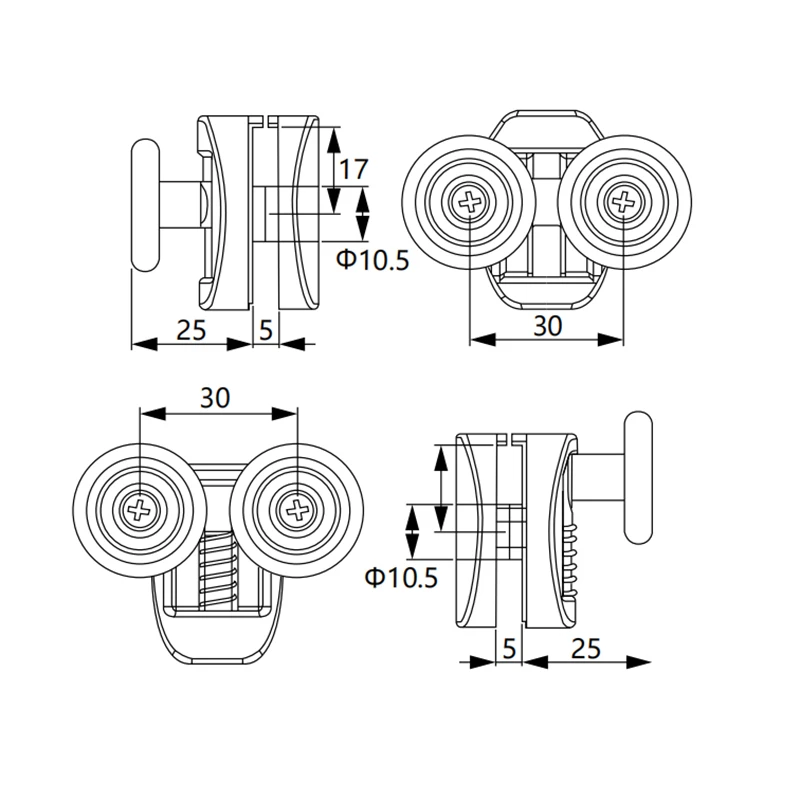
Recommended image:
A simple technical measurement diagram showing:
- Wheel Diameter
- Wheel Width
- Glass Hole Diameter
- Edge Distance
- Wheel Offset
This can be a clean technical illustration rather than a product photo.